
Quick Answer
A well-designed school uniform policy can create a clear visual standard, simplify family shopping decisions, support school identity and reduce daily uncertainty about what students may wear. The policy works best when approved products are accessible, requirements are written in plain language, accommodations are handled respectfully and enforcement is predictable. Research on automatic improvements in attendance, behavior or achievement is mixed, so schools should judge success by their own goals and data rather than making broad promises.
Key Takeaways
- Connect every uniform requirement to a clear purpose such as identification, consistency, professionalism or ease for families.
- Keep the approved assortment understandable, affordable and available across a broad size range.
- Train staff to apply the policy consistently and respectfully.
- Measure implementation outcomes such as family questions, compliance issues, lost instructional time and product availability.
Why school uniform policy design matters
A uniform policy affects students, parents, teachers, office staff, administrators and the school's public identity. When requirements are vague or products are difficult to find, a policy intended to create order can instead generate repeated questions, inconsistent enforcement and family frustration.
All Uniform Wear works with private, charter and diocesan schools to translate dress standards into practical assortments, logo applications, retail support and family shopping instructions. The strongest partnerships begin with a clear policy—not merely a list of clothing items.
What benefits can a school uniform policy provide?
Uniform policies can simplify acceptable-dress expectations, make students easier to identify as members of the school community, reinforce visual identity and reduce the number of fashion decisions families make on school mornings. They may also help staff distinguish approved from unapproved garments more efficiently.
Avoid promising outcomes the policy cannot guarantee
Studies of uniforms and student behavior, attendance, belonging and achievement have produced mixed findings. A uniform policy is an operational and cultural tool, not a substitute for strong teaching, relationships, student support, safety procedures or fair discipline.
- Clarity: Families know the expected colors, garments, logos, layers and footwear.
- Identity: A coordinated appearance can reinforce belonging and present a recognizable school image.
- Operational consistency: Staff spend less time interpreting highly subjective clothing choices when the written standard is precise.
What should a school uniform policy include?
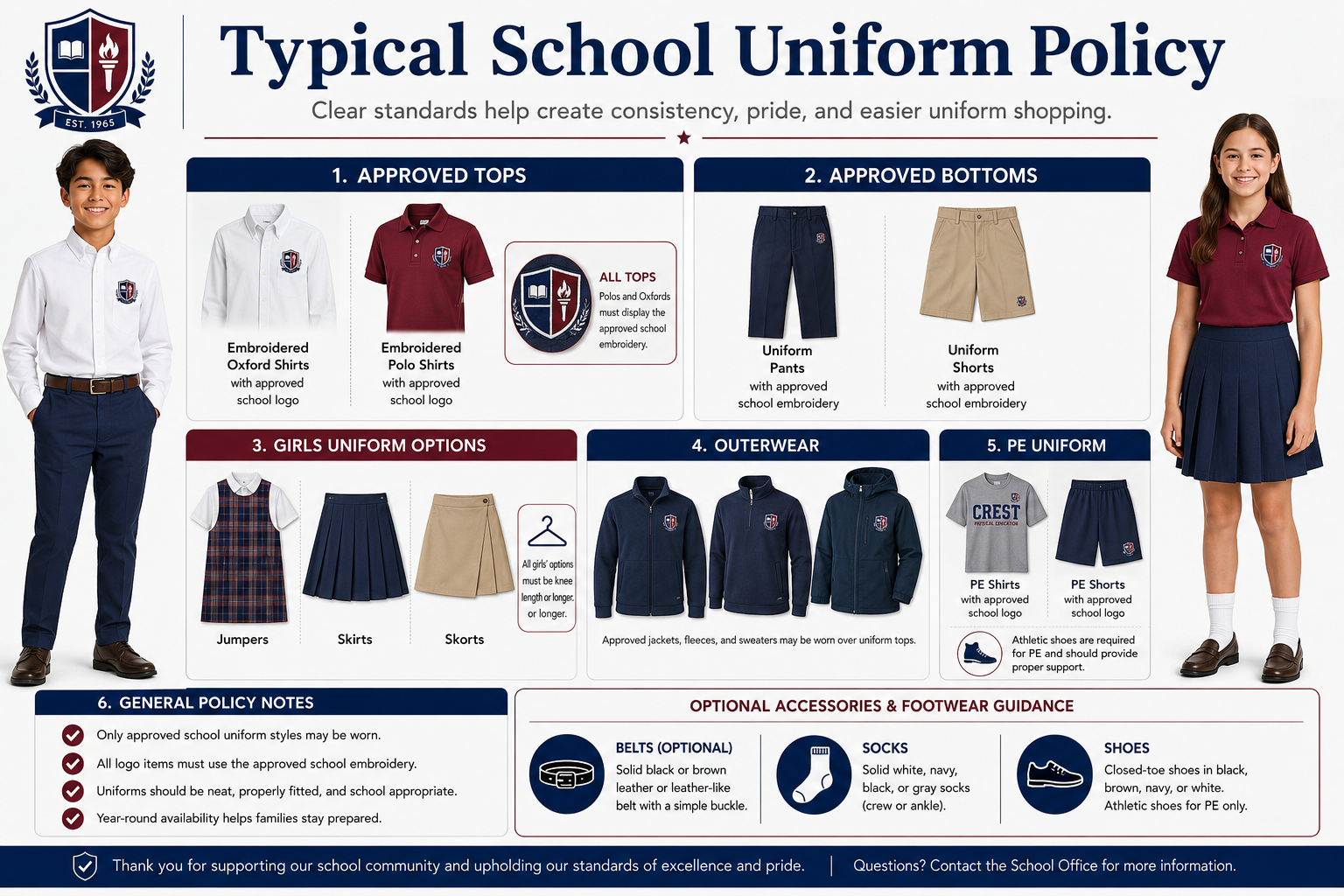
A practical policy should define approved garments and colors, logo rules, fit and length expectations, outerwear, footwear, spirit days, seasonal options, grooming or accessory rules where applicable, financial assistance, accommodations and the process for addressing noncompliance.
Decision Guide
| Area | Recommended approach | Why it matters |
|---|---|---|
| Product standard | Exact garment types, colors, logos and acceptable alternatives | Prevents families from interpreting generic terms differently |
| Access and affordability | Where to buy, expected price range, assistance and used-uniform options | Supports equitable participation |
| Exceptions and accommodations | Religious, disability, medical, sensory and other legitimate needs | Creates a respectful review process |
| Enforcement process | Who addresses issues, communication steps and opportunities to correct | Reduces inconsistent or public confrontation |
How should school leaders implement and enforce the policy?
- Define the objective: Agree on what the uniform program is intended to accomplish and what it is not expected to solve.
- Engage stakeholders: Gather input from leadership, teachers, business staff, families and students before final approval.
- Publish practical instructions: Use photos, exact colors, product examples, deadlines, FAQs and vendor information.
- Enforce with consistency and dignity: Train staff, offer a reasonable correction process and review outcomes after each season.
Sources and Additional Information
Common Questions
Frequently Asked Questions About The Benefits of a Clear and Consistent School Uniform Policy
Do school uniforms automatically improve behavior or grades?
No. Research is mixed, and uniforms should not be presented as a guaranteed academic or disciplinary intervention.
Should every student be required to buy from one vendor?
That decision belongs to the school. A controlled vendor arrangement can improve color and logo consistency, but the school should also evaluate access, affordability, service and contingency planning.
How often should a uniform policy be reviewed?
Review it annually and whenever the school changes branding, grade levels, facilities, climate needs, student activities or approved products.
A uniform policy succeeds through clarity, access and consistency
School uniforms can support a recognizable, orderly and easier-to-understand dress standard when the policy is carefully designed. The greatest benefits come from precise expectations, practical access, respectful accommodations, reliable products and consistent administration.
