
Quick Answer
A practical scrub color and embroidery system should make employees easier to identify without creating unnecessary complexity. Assign colors only when they serve a clear operational purpose, specify exact manufacturer color names and approved style numbers, and document logo, name, title and credential formatting. Test the complete system with employees and patient-facing leaders before rollout, then maintain a controlled list for new hires and reorders.
Key Takeaways
- Use color coding only when it improves identification, consistency or department organization.
- Specify exact products and shades; generic terms such as blue, gray or green are not precise enough.
- Create one embroidery proof and written standard before producing employee garments.
- Include title and credential governance so outdated or inconsistent designations are not reproduced.
Why uniform identification standards need more than a color chart
Scrub color coding can help patients, families and coworkers recognize roles, but a complicated system can become difficult to remember and expensive to maintain. Color is also only one part of identification. Badges, introductions, signage and workflow remain important.
Embroidery adds another layer of permanence. A misspelled name, outdated credential or inconsistent logo placement can be repeated across dozens of garments unless the buyer uses a controlled approval process. The strongest standard joins color, product, embroidery and reorder rules in one document.
How should a healthcare organization choose scrub colors?
Begin with the identification problem the organization is trying to solve. A small practice may need one brand color for the entire team. A larger clinic may distinguish clinical and administrative roles. A multi-department organization may use several colors, but each additional color creates training, inventory and substitution considerations.
Evaluate colors as physical garments
Screens and printed charts do not always represent fabric shades accurately. Review actual samples under the lighting used at the facility and compare coordinated tops, pants, jackets and maternity or extended-size options.
- Recognition: Choose colors that are visually distinct enough for the intended role categories.
- Availability: Confirm the shade exists across approved cuts, sizes, layers and replacement products.
- Practicality: Consider opacity, fading, stain visibility, brand compatibility and workplace policy.
What should a medical embroidery standard include?
The standard should define the approved logo artwork, thread colors, size, placement and text hierarchy. It should also explain whether garments display an employee name, job title, department, professional credential or location. Every variable should have an owner who can approve changes.
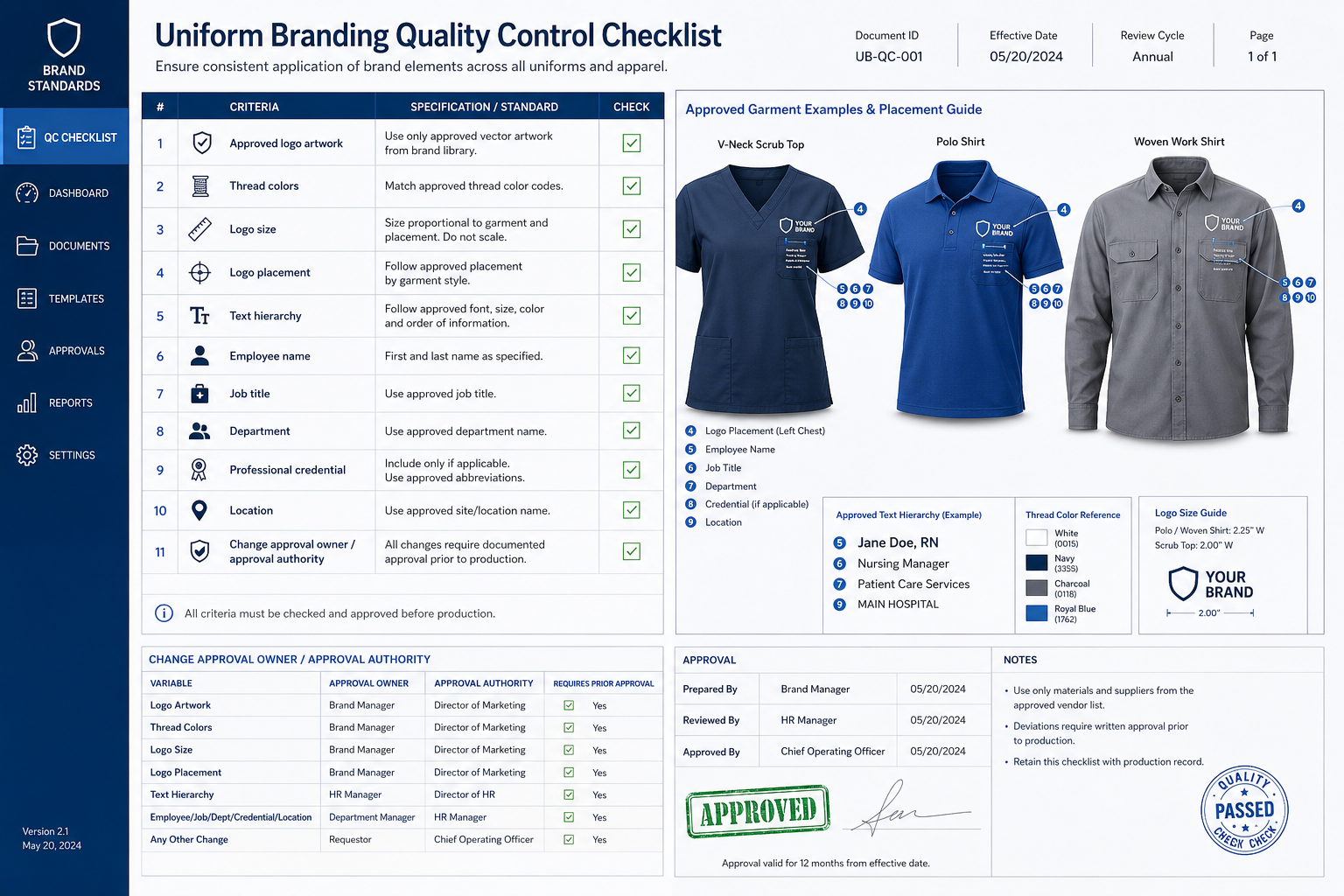
Decision Comparison
| Option or situation | Best use or action | Important consideration |
|---|---|---|
| Organization logo | Approved artwork, size, thread colors and placement | Use one production-ready master proof |
| Employee name | Preferred name format, capitalization and character limits | Require employee verification |
| Title or department | Approved terminology and line order | Avoid informal or inconsistent abbreviations |
| Professional credential | Eligible credentials and verification owner | Update when licensure or role changes |
How to document and maintain the standard
- Create the uniform matrix: List each role, approved color, garment styles, layers and footwear or accessory rules.
- Approve embroidery proofs: Review logo proportions, text spelling, placement and thread colors on the actual fabric.
- Control ordering: Give employees and purchasing staff access only to the current approved assortment.
- Audit and update: Review discontinued styles, role changes, credentials, new locations and employee feedback on a defined schedule.
Sources and Additional Information
This resource provides general uniform-planning information. Healthcare organizations and employees should follow their own infection-control, safety, human-resources and professional-practice requirements.
Common Questions
Frequently Asked Questions About Scrub Color and Embroidery Standards
Is scrub color coding required for healthcare organizations?
Requirements depend on the employer, facility and applicable policies. Many organizations use color coding as an internal identification and branding choice rather than a universal legal requirement.
Can different scrub brands be mixed if the color name is the same?
Not safely without comparing samples. Identical or similar color names can differ between manufacturers, fabrics and production lots.
Should credentials be embroidered directly on scrubs?
Only when the organization has a verification and update process. A credential standard should specify which designations are permitted and who confirms accuracy before production.
Make the standard easy to recognize and easy to repeat
An effective color and embroidery system is simple enough for patients and employees to understand and specific enough for purchasing teams to reproduce. Exact products, approved proofs, credential governance and a controlled reorder process protect consistency long after the initial rollout.