

Quick Answer
A business uniform program turns a company's dress and branding requirements into a repeatable system. The company approves garments, colors, logo placement, employee eligibility, payment rules and ordering methods. Employees or managers then order from the approved assortment, the garments are decorated according to the saved branding standard, and orders are fulfilled through the chosen store, portal, group-order or shipping process. Strong programs also define exchanges, new-hire ordering, replacements, discontinued-product substitutions and ongoing account support.
Key Takeaways
- Begin with the company's operational and brand requirements before selecting garments.
- Save one approved logo, thread-color, placement and text standard for all future production.
- Choose an employee ordering method that matches headcount, locations, budgets and internal administration.
- Plan new-hire orders, repeat orders, exchanges and discontinued styles before the initial rollout.
What a business uniform program actually manages
A business uniform program is more than a one-time purchase of embroidered shirts. It is an operating process for deciding what employees wear, who is eligible, how branding is reproduced, how orders are paid for and how new or replacement garments are supplied.
All Uniform Wear supports corporate teams, hospitality operations, service organizations, professional offices and multi-location businesses with approved apparel assortments, in-house embroidery, sizing assistance, group ordering, employee access and ongoing reorder support. The goal is to make the company's visual standard easier to repeat as the workforce changes.
What decisions come before product selection?
The organization should first identify who wears the uniform, the environments in which employees work, the desired level of formality, the physical demands of each role and the customer-facing image the company wants to present. These decisions determine whether the approved assortment should include polos, button-down shirts, blouses, jackets, performance apparel, workwear, hospitality pieces or a combination.
Create a written uniform matrix
A uniform matrix lists every role or department alongside its approved garments, colors, logo treatment, quantity or allowance and optional layers. This becomes the shared reference for procurement, managers, employees and the uniform provider.
- Employee groups: Identify departments, locations, job functions and any role-specific apparel needs.
- Approved assortment: Record exact style numbers, colors, acceptable alternatives and seasonal layers.
- Program rules: Define eligibility, employer contribution, employee payment, replacement timing and exception approval.
How do employee ordering, embroidery and fulfillment work?
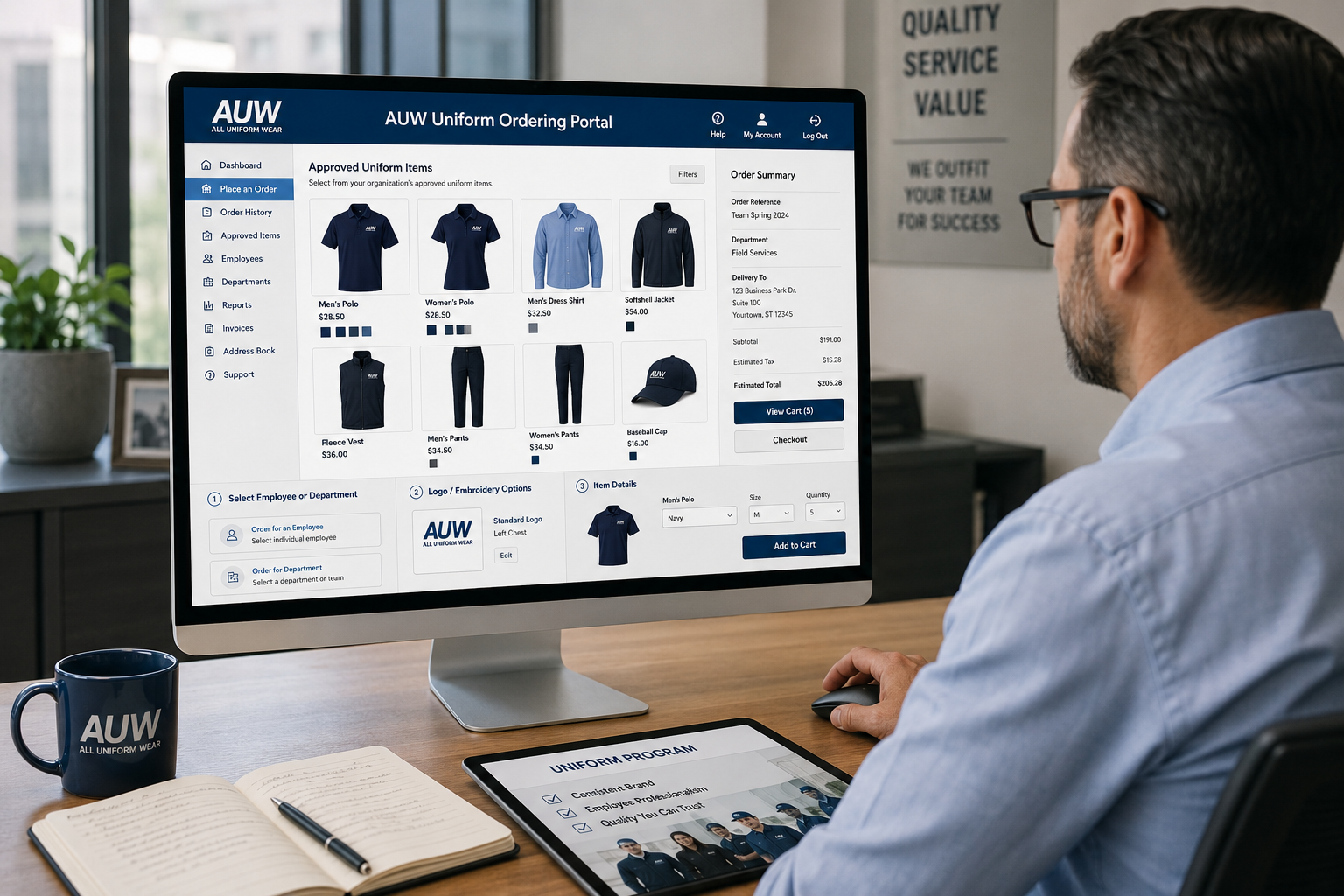
Ordering can be centralized through procurement, placed by managers, completed by employees through an approved portal or handled through a hybrid process. Once the order is confirmed, the garments are embroidered or otherwise decorated using the approved logo and placement standard, then prepared for pickup, delivery or shipment.
Decision Guide
| Area | Recommended approach | Important consideration |
|---|---|---|
| Central group order | Procurement collects sizes and submits one consolidated order | Strong control; requires internal coordination and roster accuracy |
| Employee ordering portal | Employees select from a secured approved assortment | Convenient for distributed teams; eligibility and payment rules must be configured |
| Manager-managed ordering | Location or department managers place approved employee orders | Useful for decentralized operations with local oversight |
| Hybrid program | Initial issue is centralized and later replacements are employee-directed | Balances launch control with repeat-order convenience |
How does the program continue after launch?
- Save the approved standard: Retain style numbers, colors, logo files, thread colors, placements and employee text rules.
- Create the new-hire process: Define who authorizes the order, how sizing occurs and how quickly the employee needs the garments.
- Establish repeat-order rules: Document replacement timing, employee allowances, payment methods and lost or damaged garment procedures.
- Review program performance: Track availability, exchanges, employee feedback, logo changes, discontinued products and multi-location consistency.
Sources and Additional Information
Common Questions
Frequently Asked Questions About How Business Uniform Programs Work
Can employees order uniforms individually?
Yes. Depending on the program design, employees may order from a restricted assortment through a portal, store or approved ordering process.
Can different departments wear different garments?
Yes. A uniform matrix can assign coordinated colors or garment types by role while maintaining a consistent company logo and overall brand image.
What happens when an approved style is discontinued?
The account owner and uniform provider should select a documented replacement, compare color and fit, update the approved assortment and communicate the change.
A uniform program is a repeatable business process
The strongest business uniform programs make the correct choice easy for employees and easy for management to reproduce. Clear product standards, controlled branding, a practical ordering method and ongoing account support turn branded apparel into an organized operating system rather than a series of emergency purchases.
