

Quick Answer
Uniform procurement should be managed as a recurring category rather than a one-time apparel order. Buyers should define approved products and branding, estimate eligible headcount and replacement demand, establish pricing and payment rules, collect accurate employee data, select the ordering and fulfillment model and document approval responsibilities. Total program cost includes administrative time, exchanges, unavailable products, decoration errors, rush orders and inconsistent reorders—not only the garment price.
Key Takeaways
- Use exact style numbers, colors and decoration standards instead of broad descriptions.
- Budget for new hires, replacements, size exchanges, seasonal needs and product discontinuations.
- Protect employee information and limit access to the data required for ordering and fulfillment.
- Evaluate vendors on service, consistency, embroidery control and reorder capability as well as price.
Why uniform purchasing needs procurement discipline
A buyer may source a strong garment at a competitive price and still end up with a difficult program. Missing sizes, inconsistent logo files, inaccurate rosters, decentralized purchases and unplanned repeat orders can create more cost than the initial product selection.
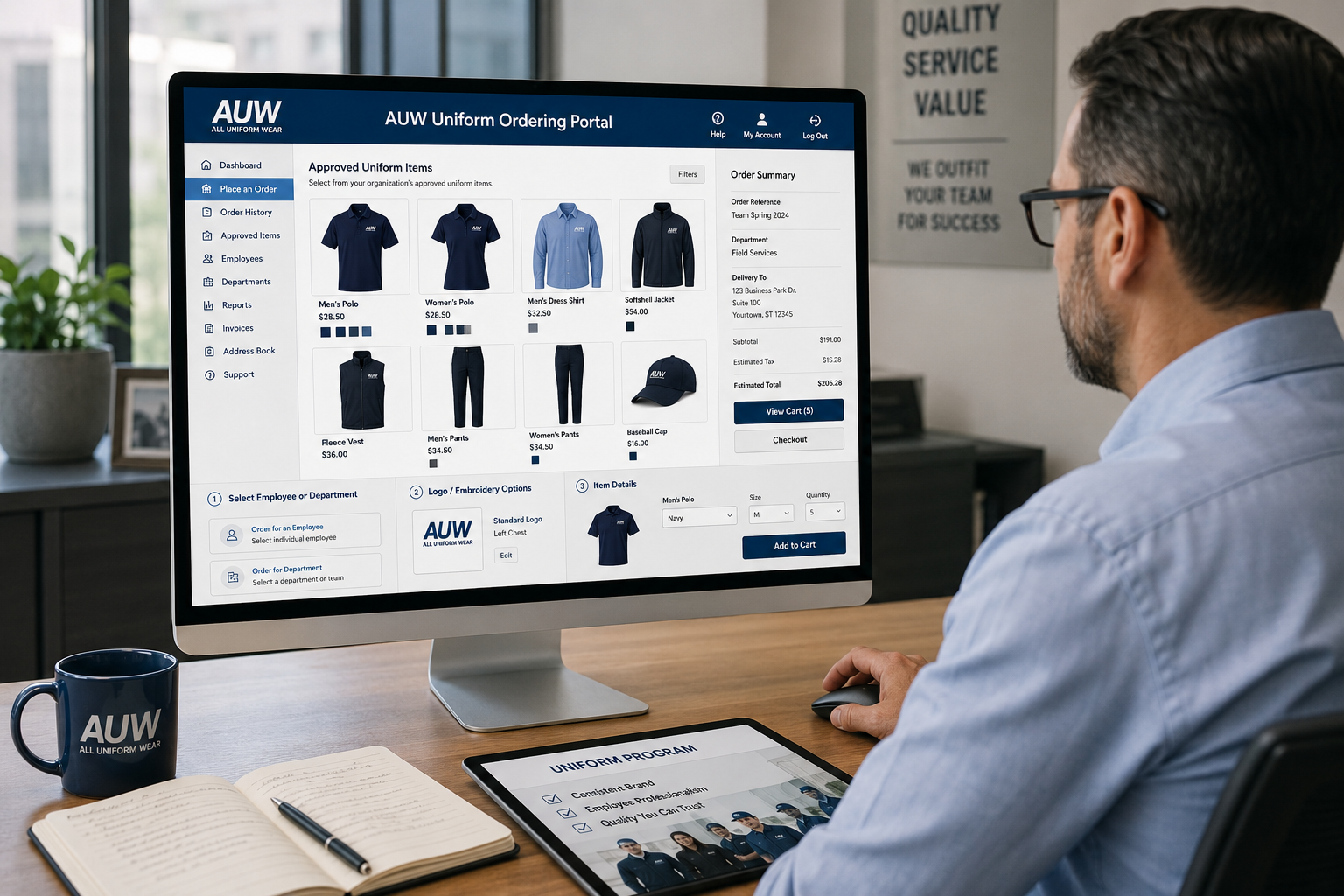
Procurement officers, office managers and marketing leaders each control part of the result. AUW supports businesses with approved product assortments, group orders, employee ordering options, in-house embroidery, account coordination and repeat ordering so the company can manage both the first rollout and daily program activity.
What belongs in a business uniform specification?
The specification should include the exact garment, color, size range, logo file, thread colors, decoration location, employee text, packaging or distribution requirements and acceptable substitutions. It should also state who may approve changes.
Separate required standards from preferences
Required standards protect brand, safety and operational needs. Preferences—such as one employee's preferred pocket or collar—should be considered only when they do not create uncontrolled assortment growth or sourcing problems.
- Product data: Manufacturer, style number, color, size range, fabric, care and approved alternatives.
- Decoration data: Logo version, thread colors, placement, size, names, titles and proof approval.
- Commercial data: Price structure, setup charges, freight, taxes, purchase orders, allowances and payment responsibility.
Which purchasing and fulfillment model should a buyer choose?
The right model depends on workforce size, turnover, locations, employee payment responsibility and internal staffing. Centralized orders provide control, while employee ordering can reduce roster management. Multi-location companies may combine corporate standards with local fulfillment or nationwide shipping.
Decision Guide
| Area | Recommended approach | Important consideration |
|---|---|---|
| Purchase order program | Company pays and authorizes orders under agreed terms | Useful for controlled organizational purchasing |
| Employee allowance | Company funds a defined balance or quantity | Requires eligibility, expiration and overage rules |
| Employee-paid approved store | Employee purchases from the approved assortment | Reduces company payment administration |
| Multi-location fulfillment | Orders are routed to stores, departments, homes or locations | Requires consistent standards and delivery data |
How to control repeat orders and program cost
- Forecast demand: Estimate initial issue, annual replacement, new-hire volume, seasonal layers and growth.
- Control employee data: Use a current roster with only the information needed for eligibility, sizing, decoration and delivery.
- Approve before production: Verify art, spelling, quantities, sizes, shipping and payment before decoration begins.
- Review total program performance: Measure backorders, exchanges, rush orders, decoration errors, employee questions and discontinued styles.
Sources and Additional Information
Common Questions
Frequently Asked Questions About Business Uniform Procurement Guide for Buyers and Office Managers
How should a buyer compare uniform vendors?
Compare product availability, size support, decoration quality, ordering options, account service, fulfillment, substitutions and repeat-order accuracy in addition to unit price.
Should procurement or marketing control the logo standard?
Marketing or brand leadership should approve the visual standard, while procurement controls the purchasing process. One documented final standard should be used by both.
How much replacement inventory should a company hold?
That depends on turnover, lead times, employee roles and storage capacity. Many companies benefit from a small controlled reserve or a reliable rapid reorder process rather than excessive inventory.
Control the program, not only the purchase order
Professional uniform procurement connects brand approval, employee data, product availability, decoration and fulfillment into one controlled process. Buyers who plan for recurring demand and total program cost can reduce last-minute orders while keeping employees and locations consistently outfitted.
